Love The Lord Your God

you-shall-love-the-lord-your-god-1-1175530-639x424
Photo by Mike Thorn

When someone mentions the commands of God, or the law of God, what comes to your mind? The book of Leviticus? The Ten Commandments? Hell fire and brimstone?
As we’ve discussed before, the Ten Commandments can be found in Exodus 20. In the midst of the do’s and don’ts, there is something interesting. Look at verses 4-6, paying particular attention to verse six

4.“You shall not make for yourself an image in the form of anything in heaven above or on the earth beneath or in the waters below. 5.You shall not bow down to them or worship them; for I, the Lord your God, am a jealous God, punishing the children for the sin of the parents to the third and fourth generation of those who hate me, 6.but showing love to a thousand generations of those who love me and keep my commandments.

Do you see it?

but showing love to a thousand generations of those who love me and keep my commandments. (Ex 20:6)

We know that God expects obedience to His commands, but did you realize He wants us to love Him?

Moses didn’t miss it. The book of Deuteronomy is Moses’ farewell to the Israelites. He recounts their journey together from the time they left Egypt, repeats much of the law, and admonishes them to be faithful and obedient to God. Nine different times, he mentions loving God.

Love the Lord your God with all your heart and with all your soul and with all your strength. (Deut 6:5)

And now, Israel, what does the Lord your God ask of you but to fear the Lord your God, to walk in obedience to him, to love him, to serve the Lord your God with all your heart and with all your soul, (Deut 10:12)

Love the Lord your God and keep his requirements, his decrees, his laws and his commands always. (Deut 11:1)

So if you faithfully obey the commands I am giving you today—to love the Lord your God and to serve him with all your heart and with all your soul— (Deut 11:13)

If you carefully observe all these commands I am giving you to follow—to love the Lord your God, to walk in obedience to him and to hold fast to him— (Deut 11:22)

you must not listen to the words of that prophet or dreamer. The Lord your God is testing you to find out whether you love him with all your heart and with all your soul. (Deut 13:3)

because you carefully follow all these laws I command you today—to love the Lord your God and to walk always in obedience to him—then you are to set aside three more cities. (Deut 19:9)

The Lord your God will circumcise your hearts and the hearts of your descendants, so that you may love him with all your heart and with all your soul, and live. (Deut 30:6)

For I command you today to love the Lord your God, to walk in obedience to him, and to keep his commands, decrees and laws; then you will live and increase, and the Lord your God will bless you in the land you are entering to possess. (Deut 30:16)

and that you may love the Lord your God, listen to his voice, and hold fast to him. For the Lord is your life, and he will give you many years in the land he swore to give to your fathers, Abraham, Isaac and Jacob. (Deut 30:20)

When Moses died, Joshua took his place. He thought loving God was important too.

But be very careful to keep the commandment and the law that Moses the servant of the Lord gave you: to love the Lord your God, to walk in obedience to him, to keep his commands, to hold fast to him and to serve him with all your heart and with all your soul.” (Joshua 22:5)

So be very careful to love the Lord your God. (23:11)

There are 57 other verses that mention loving God. That isn’t much when you consider there word love is found over 600 times in the Bible. Many times it refers to God’s love for us, not our love for Him. So how does one go about loving God? Well, read the verses above again. You’ll notice that love and obedience are often mentioned together. Ten of those 57 verses were written by David in the Psalms, and he specifically says that he loves the actual commands of God. Most of the time however, loving God is mentioned before obedience to Him. Does obedience flow naturally from a love relationship? What happens when there is no love in obedience?

The Lord says: “These people come near to me with their mouth and honor me with their lips, but their hearts are far from me. Their worship of me is based on merely human rules they have been taught. (Is 29:13)

Sadly, scriptures are full of examples of people who obeyed the law, but did not appear to love God. More sadly, the church is full of examples too. Why is that? Could it be that people are taught human rules about religion instead of being lead to a love relationship with God? God demands our obedience, but He would rather it come from a heart full of love than a heart full of fear and resentment. That isn’t the kind of relationship He wants with us. Did you only obey your parents because you feared punishment?

More about that next week.

Connie
Songs for Sunday: He’s Alive!

Happy Resurrection Day!

Choosing just one song for this day was hard! There are so many great songs, but I had to go back to the one that has been my favorite since the first time I heard it. I was probably fourteen years old, when I heard Don Francisco’s “He’s Alive” on Christian radio. It’s the resurrection story told from Peter’s perspective. It was powerful stuff then, and it still is 40 years later.

He’s Alive

The gates and doors were barred and all the windows fastened down,
I spent the night in sleeplessness and rose at every sound,
Half in hopeless sorrow half in fear the day,
Would find the soldiers breaking through to drag us all away.

Then just before the sunrise I heard something at the wall,
The gate began to rattle and a voice began to call,
I hurried to the window and looked down to the street,
Expecting swords and torches and the sound of soldiers feet,

There was no one there but Mary so I went down to let her in,
John stood there beside me as she told us were she’d been,
She said they moved him in the night and none of us knows where,
The stones been rolled away and now his body isn’t there.

We both ran toward the garden then John ran on ahead,
We found the stone and the empty tomb just the way that Mary said,
But the winding sheet they wrapped him in was just an empty shell,
And how or where they’d taken him was more than I could tell.

Something strange had happened there but what I did not know,
John believed a miracle but I just turned to go,
Circumstance and speculation couldn’t lift me very high,
Cause I’d seen them crucify him and then I saw him die,

Back inside the house again all the guilt and anguish came,
Everything I’d promised him just added to my shame,
‘Cause when at last it came to choices I denied I knew his name,
Even If he was alive it wouldn’t be the same.

But suddenly the air was filled with a strange and sweet perfume,
Light that came from everywhere drove shadows from the room,
Jesus stood before me with his arms held open wide,
And I fell down on my knees and clung to him and cried,

He raised me to my feet and as I looked into his eyes,
Love was shining out from him like sunlight from the sky,
Guilt and my confusion disappeared in sweet release,
And every fear I’d ever had just melted into peace.

He’s alive, He’s alive, He’s alive and I’m forgiven,
Heavens gates are open wide.
He’s alive, He’s alive, He’s alive and I’m forgiven,
Heavens gates are open wide.
He’s alive, He’s alive, He’s alive and I’m forgiven,
Heavens gates are open wide.

He’s alive!
The song was included on Don’s second album called, “Forgiven”, in 1977. Many other artists have recorded it, the most well known probably being Dolly Parton. I love Dolly’s music, but for me, no one does the song like the man who wrote it.

This YouTube video is only a couple years old, and I think Don sounds just as good as he did 40 years ago; maybe better.

See you in church!

Connie

Good Friday

Today is Good Friday, the day we remember Jesus’ death.

I’ve spent the last few days talking to the Lord, and trying to determine what He wanted me to say about it.

For God so loved the world that he gave his one and only Son, that whoever believes in him shall not perish but have eternal life (John 3:16)

That’s it.

God intended for us to have a personal relationship with Him. Adam and Eve had it in the garden, before they disobeyed God’s word and put the whole Earth under a curse.

God longs to have that relationship with us again, but only the sacrifice of a sinless life could do that.  That’s a problem, because there isn’t one human being who can live a totally sinless life.

God, however had a plan. He would send His son to live that sinless life, so that he would be the perfect sacrifice.

That’s what He did.

He sent Jesus to live as a human being. The only difference was that He would live a perfect life, and then, when it was the right time, He would offer up His own life in our place.

And that is what Jesus did.

When the work was complete,

…Jesus said, “It is finished.” With that, he bowed his head and gave up his spirit. (John 19:30)

What was finished? Our redemption.

For God did not send his Son into the world to condemn the world, but to save the world through him. (John 3:17)

Hold on though, that’s not the end of the story…it’s just the beginning.

Like this song performed by David Phelps

Connie

Songs for Sunday: All Glory Laud and Honor

Palm Sunday marks the beginning of Holy Week, which culminates next Sunday on Easter, or as I prefer to call it, Resurrection Day! I can think of all kinds of music for the death, burial, and glorious resurrection of my Lord, but songs commemorating the triumphal entry into Jerusalem escape me, except for this one.  The funny thing is that I don’t think I’ve ever sung it, except for a few lines that were included in an Easter cantata. It is in several hymnals, including the one we use at our church. I heard someone else sing it once, a long time ago.

The words  were written by Theodulph of Orleans about the year 820. Theodulph, according to Cyberhymnal.com, was appointed as Bishop of Orleans, France by Charlemagne, but when the king died, his successor was suspicious of the bishop and had him imprisoned.  It was during his imprisonment, that he wrote the words to “All Glory Laud and Honor”.  He never regained his freedom, and died in 821. He was about sixty years old.

All glory, laud and honor,
To Thee, Redeemer, King,
To Whom the lips of children
Made sweet hosannas ring.
Thou art the King of Israel,
Thou David’s royal Son,
Who in the Lord’s Name comest,
The King and Blessèd One.

The company of angels
Are praising Thee on High,
And mortal men and all things
Created make reply.
The people of the Hebrews
With palms before Thee went;
Our prayer and praise and anthems
Before Thee we present.

To Thee, before Thy passion,
They sang their hymns of praise;
To Thee, now high exalted,
Our melody we raise.
Thou didst accept their praises;
Accept the prayers we bring,
Who in all good delightest,
Thou good and gracious King.

The music was written in 1615, by German composer, Melchior Teschner, who called the piece “St Theodulph”. John M. Neal translated the Latin words into English in 1851.

Here is a YouTube video from WorshipOnYT

For me, the funny thing is that, when I heard it sung way back when, St Theodulph was not the melody. I don’t know what it was, and I have never heard it that way again. I was in high school, and our preacher’s wife sang it. It must have been during some kind of rehearsal for Palm Sunday/Easter, because I remember being there a lot when she rehearsed. The melody was unique, and it stuck with me.  If anyone else has an idea of what it could have been, feel free to comment below.

See you in church!

Connie

Palm Sunday

Palm Sunday always comes the Sunday before Easter. On that day, we remember Jesus’
“Triumphal Entry” into Jerusalem. The event is recorded in all four gospels: Matthew 21:1-11, Mark 11:1-11, Luke 19:29-40, and John 12:12-19.

Before we look at those, look at Zechariah chapter nine. You can read it online here.

This prophecy promises deliverance for God’s people. However, if you look closely, you’ll see something odd.

Rejoice greatly, Daughter Zion!
Shout, Daughter Jerusalem!
See, your king comes to you,
righteous and victorious,
lowly and riding on a donkey,
on a colt, the foal of a donkey.
(Zech 9:9)

Normally, victorious kings ride horses; majestic, magnificent horses. Here it says the king will be riding a…donkey? Yes, that is what it says.

Let’s look at Matthew’s account of what happened that day.

As they approached Jerusalem and came to Bethphage on the Mount of Olives, Jesus sent two disciples, saying to them, “Go to the village ahead of you, and at once you will find a donkey tied there, with her colt by her. Untie them and bring them to me. If anyone says anything to you, say that the Lord needs them, and he will send them right away.”This took place to fulfill what was spoken through the prophet:

Say to Daughter Zion,
‘See, your king comes to you,
gentle and riding on a donkey,
and on a colt, the foal of a donkey.’”

The disciples went and did as Jesus had instructed them. They brought the donkey and the colt and placed their cloaks on them for Jesus to sit on. A very large crowd spread their cloaks on the road, while others cut branches from the trees and spread them on the road. The crowds that went ahead of him and those that followed shouted, “Hosanna to the Son of David!” “Blessed is he who comes in the name of the Lord!”“Hosanna in the highest heaven!”When Jesus entered Jerusalem, the whole city was stirred and asked, “Who is this?” The crowds answered, “This is Jesus, the prophet from Nazareth in Galilee.” (Matt: 21:1-11)

Mark doesn’t really add anything to the narrative, but Luke says some of the Pharisees were offended at what the crowd was shouting.

Some of the Pharisees in the crowd said to Jesus, “Teacher, rebuke your disciples!” “I tell you,” he replied, “if they keep quiet, the stones will cry out.” (Luke 19:39-40)

John adds,

At first his disciples did not understand all this. Only after Jesus was glorified did they realize that these things had been written about him and that these things had been done to him. Now the crowd that was with him when he called Lazarus from the tomb and raised him from the dead continued to spread the word. Many people, because they had heard that he had performed this sign, went out to meet him. So the Pharisees said to one another, “See, this is getting us nowhere. Look how the whole world has gone after him!” (John 12:16-19)

When Jesus came into Jerusalem on the back of the donkey, He was proclaiming Himself as Messiah. It was just a few days after He had raised Lazarus from the dead, and the multitudes came out to welcome to Him. The phrase “Blessed is he who comes in the name of the Lord!” is from Psalm 118, which contains another piece of messianic prophecy. Calling Him “Son of David” referred to prophecy from Isaiah and 2nd Samuel.

By shouting those things, the people were also proclaiming Jesus as messiah. The people knew the prophecies. They really didn’t understand what it was all about though. They were looking for an earthly king. During Jesus time on earth, Israel was under the rule of the Roman Empire. The Jewish people desperately wanted deliverance from the Romans, and they expected their messiah to deliver them. He didn’t though, and the crowds that welcomed Him would soon be calling for His crucifixion. If they had really understood the prophecies, they would have known that was part of the plan.

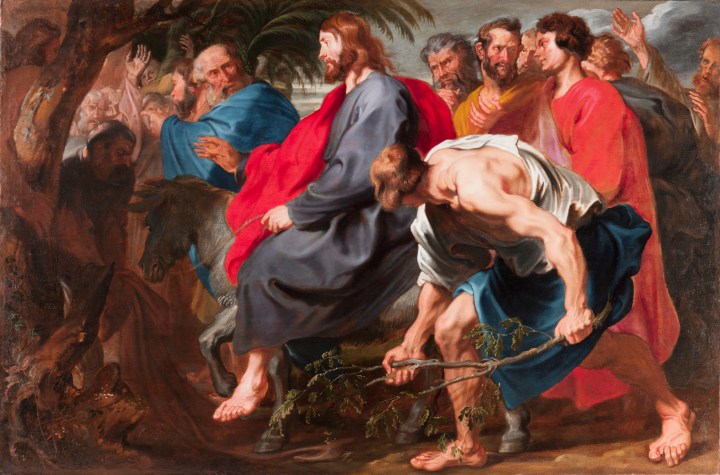
1_original
“Entry of Christ into Jerusalem” Anthony Van Dyck (1599-1641) oil on canvas, public domain, downloaded from Indianapolis Museum of Art

What are your expectations of Jesus?

Connie

Songs for Sunday: Lonely Voices

The first time I heard this song, I was probably about 12 years old, and visiting my grandparent’s church in Bixby Oklahoma. It was sung by the youth minister’s wife. Her name was Nina, and she had the sweetest voice. I thought the lyrics and melody were both hauntingly beautiful.

Here is a YouTube video from Bethel Church.

Lonely voices crying in the city,
Lonely voices sounding like a child.
Lonely voices come from busy people,
Too disturbed to stop a little while.
Lonely voices fill my dreams,
Lonely voices haunt my memory.

Lonely faces looking for the sunrise,
Just to find another busy day.
Lonely faces all around the city,
Men afraid, but too ashamed to pray.
Lonely faces do I see,
Lonely faces haunt my memory.

Lonely eyes, I see them in the subway,
Burdened by the worries of the day;
Men at leisure, but they’re so unhappy,
Tired of foolish roles they try to play.
Lonely people do I see,
Lonely people haunt my memory.

Abundant life He came to truly give man,
But so few His gift of grace receive.
Lonely people live in every city,
Men who face a dark and lonely grave.
Lonely faces do I see,
Lonely voices calling out to me.

The song was written in 1967 by Billie Hanks Jr, who was part of the Billy Graham crusades. You can find out what he is doing now here. George Beverly Shea, who was also a familiar face at the crusades, recorded the song on his album If That Isn’t Love

I still love the melody, but lyrics bother me a little. While the song points out the problem of the lonely people who obviously need to know the Lord, the writer appears to be only an observer, and fails to do anything about the need. Were the lonely voices haunting this person’s memory because they didn’t tell those people about the Lord, when they should have?

How many of us are like that? How often do we sadly shake our heads, and say that person “needs the Lord”, but never tell them about Jesus? Guilty as charged. We….I…have to do better. Jesus told us to tell others about Him. We need to answer the lonely voices with the news of the Savior!

See you in church!

Connie

Practical Application

My grandfather was a preacher. You might assume that means that all his children, grandchildren and great grandchildren followed the straight and narrow, went to Bible college, and either became or married preachers. Not exactly. We all went the prodigal route, and some of us are still out there.

Grandpa memorized massive amounts of scripture, and could call up a scriptural response for just about any situation. He did that often, and most times in lieu of any other advice. One time, in frustration, one of my cousins said, “That’s great Grandpa, but how does that apply to me?” He needed to know the practical application of what my grandfather had said. I’m not sure if he got the answer he was looking for.

We all need practical application. How do we take what the Bible says, and apply it to our lives today. I know a lot of scripture too, but I’ve learned that there is a huge difference between knowing the words, and knowing the Source of those words. It is possible to “talk the talk” without even knowing how to “walk the walk”.

We spend a lot of time on this blog looking at what the scriptures say, looking at the original languages, looking at how wonderfully everything fits together. I want to do everything I can to give us a clearer picture of God’s message to us. However, all that is worthless, if we choose not to, or can’t figure out how to, apply it to our lives.

Sometimes, even what appears to be a biblical lesson in practical application can be confusing.

Look at this passage from Paul’s letter to the church in Rome:

“If it is possible, as far as it depends on you, live at peace with everyone. Do not take revenge, my dear friends, but leave room for God’s wrath, for it is written: ‘It is mine to avenge; I will repay,’ says the Lord. On the contrary:

‘If your enemy is hungry, feed him;
if he is thirsty, give him something to drink.
In doing this, you will heap burning coals on his head.’

Do not be overcome by evil, but overcome evil with good” (Romans 12:18-21)

Ok, at first glance that seems pretty straight forward. Do your part to get along with everyone (yes, this is hard sometimes). Seeking revenge is not your job; it’s God’s (yes, that’s hard too). So how do we do that? If your enemy (or just that jerk of a neighbor you can’t stand) is hungry, you feed him. You help get his physical needs met. Ok, but what is this? “heap burning coals on his head”? What does that mean? It kind of sounds like “kill them with kindness”, but is it? That still kind of sounds like a revenge-like response.

This is where it helps to understand the culture of the day.

This is a quote from the Bible Knowledge Commentary that I found here.

“Sometimes a person’s fire went out and he needed to borrow some live coals to restart his fire. Giving a person coals in a pan to carry home “on his head” was a neighborly, kind act; it made friends, not enemies.”
burning coals
So, the goal is to turn our enemies into friends. Friends that we can maybe then lead to Jesus? It’s not killing someone with kindness; it’s loving them to the Lord! That is how we “overcome evil with good”!  I’m sure you can think of someone, even several someones, who need that.

One more thing though. Up in verse nine of this same chapter, Paul says that love must be sincere. That means we are supposed to be working from a place of genuine love for people, even unpleasant people. That is hard, and we can’t do it on our own. We can only do it through the power of Jesus in the Holy Spirit living in us, and those changes don’t happen over night. The important thing is that we make the effort. We do what He tells us, and when we feel like we can’t, we trust Him to work through us, and do it anyway. Every time we do, we look a little more like Jesus to a hungry, hurting world.

How is that for practical application?

Connie

Songs for Sunday: We Are

Hear this song first thing in the morning, and you’ll be singing it all day. That’s not necessarily a bad thing.

We Are

Every secret, every shame
Every fear, every pain
Live inside the dark
But that’s not who we are
We are children of the day

So wake up, sleeper, lift your head
We were meant for more than this
Fight the shadows, conquer death
Make the most of the time we have left

We are the light of the world
We are the city on a hill
We are the light of the world
We gotta, we gotta, we gotta let the light shine
We are the light of the world
We are the city on a hill
We are the light of the world
We gotta, we gotta, we gotta let the light shine, let the light shine, let the light shine

We are called to spread the news
To tell the world the simple truth
Jesus came to save, there’s freedom in His name
So let His love break through

We are the light of the world
We are the city on a hill
We are the light of the world
We gotta, we gotta, we gotta let the light shine
We are the light of the world
We are the city on a hill
We are the light of the world
We gotta, we gotta, we gotta let the light shine

We are the light
We are the light
We are the light
So let your light shine brighter
We are the light
We are the light
We are the light

Jesus, you are the light
You are the light
You are the light
We will lift you high and shine, shine, shine

We are the light of the world
We are the city on a hill
We are the light of the world
We gotta, we gotta, we gotta let the light shine
We are the light of the world
We are the city on a hill
We are the light of the world
We gotta, we gotta, we gotta let the light shine

We gotta shine, we gotta shine (let the light shine) [4x]

This song written by Chuck Butler, Ed Cash, James Thiele, and Hilary McBride, and recorded by Kari Jobe is taken straight from the scripture.

You are the light of the world. A town built on a hill cannot be hidden.  Neither do people light a lamp and put it under a bowl. Instead they put it on its stand, and it gives light to everyone in the house.  In the same way, let your light shine before others, that they may see your good deeds and glorify your Father in heaven. (Matt 5:14-16)

We’ll talk more about being “the light” next week.

Here is a video of Kari performing “We Are”. I was able to see her live at Women of Faith a few years ago. She is an incredible performer!

https://www.youtube.com/watch?v=cmo-g1vDGyc

See you in church!

Connie

We Have Seen His Glory

IMG_1966 (2)

The Word became flesh and made his dwelling among us. We have seen his glory, the glory of the one and only Son, who came from the Father, full of grace and truth. (John 1:14)

When John wrote “we have seen His glory” he probably meant it literally. Although John himself never describes the event, the other three gospels do. It is sometimes called the “transfiguration”. Luke tells it this way:

About eight days after Jesus said this, he took Peter, John and James with him and went up onto a mountain to pray. As he was praying, the appearance of his face changed, and his clothes became as bright as a flash of lightning. Two men, Moses and Elijah, appeared in glorious splendor, talking with Jesus. They spoke about his departure, which he was about to bring to fulfillment at Jerusalem. Peter and his companions were very sleepy, but when they became fully awake, they saw his glory and the two men standing with him. As the men were leaving Jesus, Peter said to him, “Master, it is good for us to be here. Let us put up three shelters—one for you, one for Moses and one for Elijah.” (He did not know what he was saying. While he was speaking, a cloud appeared and covered them, and they were afraid as they entered the cloud. A voice came from the cloud, saying, “This is my Son, whom I have chosen; listen to him.” When the voice had spoken, they found that Jesus was alone. The disciples kept this to themselves and did not tell anyone at that time what they had seen. (Luke 9:28-36)

Peter makes reference to the same event when he says,

For we did not follow cleverly devised stories when we told you about the coming of our Lord Jesus Christ in power, but we were eyewitnesses of his majesty. He received honor and glory from God the Father when the voice came to him from the Majestic Glory, saying, “This is my Son, whom I love; with him I am well pleased.”We ourselves heard this voice that came from heaven when we were with him on the sacred mountain. (2 Peter 1: 16-18)

There are several other New Testament references to Jesus’ glory, but as we’ve already discovered, that subject may be a little too broad for the scope of this blog. I will tell you though, that the word translated “glory” here is the Greek word “doxa”.  A discussion concerning the actual meaning of the word  can be found here.

The point I want to make is this: Both Peter and John were part of Jesus’ inner circle (along with John’s brother James). They witnessed countless miracles in the three years they spent with Jesus. Here they actually saw Jesus with Moses and Elijah in “glorious splendor”; they were in the cloud, and they still didn’t get it!

Jesus called John and his brother James, “sons of thunder” (Mark 3:17) probably because they did things like ask him if he wanted them to “call fire down from heaven” (Luke 9:54). Peter was impetuous and short tempered. When Jesus was crucified, they were  both devastated, and hid with the other disciples in “fear of the Jewish leaders” (John 20:19).

Even after the saw the resurrected Lord, they still didn’t understand. Jesus told them to wait in Jerusalem until they received the “gift from the Father” (Acts 1:4.) The gift arrived on the day of Pentecost, 40 days after Jesus had gone back to heaven.

When the day of Pentecost came, they were all together in one place. Suddenly a sound like the blowing of a violent wind came from heaven and filled the whole house where they were sitting. They saw what seemed to be tongues of fire that separated and came to rest on each of them. All of them were filled with the Holy Spirit and began to speak in other tongues as the Spirit enabled them. (Acts 2:1-4)

That day, Peter preached the first gospel message to the crowed gathered in Jerusalem.

When the people heard this, they were cut to the heart and said to Peter and the other apostles, “Brothers, what shall we do?” Peter replied, “Repent and be baptized, every one of you, in the name of Jesus Christ for the forgiveness of your sins. And you will receive the gift of the Holy Spirit. (Acts 2:38-39)

The gift of the Holy Spirit; Christ living in us. Peter and John received it on that day, as did the rest of the twelve, and the 3000 who were baptized. Jesus had told them that the Holy Spirit would help them remember (John 14:26). They remembered, they finally understood, and they were changed!

Read the rest of the book of Acts and the letters written by Peter and John to witness the amazing transformation.

Over the last 2000 years, countless live have been changed in the same way.

Has yours?

Connie

Songs for Sunday: Send the Light

Good morning! Welcome to Songs for Sunday!

This hymn is one of two that have been running around in my head for a few weeks. I decided to research it a little and share it with you. I’ll probably do the other one next week.

Send the Light

There’s a call comes ringing over the restless wave,
“Send the light! Send the light!”
There are souls to rescue there are souls to save,
Send the light! Send the light!

Refrain

Send the light, the blessèd Gospel light;
Let it shine from shore to shore!
Send the light, the blessèd Gospel light;
Let it shine forevermore!

We have heard the Macedonian call today,
“Send the light! Send the light!”
And a golden offering at the cross we lay,
Send the light! Send the light!

Refrain

Let us pray that grace may everywhere abound,
“Send the light! Send the light!”
And a Christlike spirit everywhere be found,
Send the light! Send the light!

Refrain

Let us not grow weary in the work of love,
“Send the light! Send the light!”
Let us gather jewels for a crown above,
Send the light! Send the light!

Refrain

I can remember singing this in church as a kid. I loved it then, and I still do.  The song is about spreading the gospel; fulfilling the Great Commission to “go and tell”.

The “Macedonian call” in verse 2 refers to something recorded in Acts 16.

Paul and his companions traveled throughout the region of Phrygia and Galatia, having been kept by the Holy Spirit from preaching the word in the province of Asia. When they came to the border of Mysia, they tried to enter Bithynia, but the Spirit of Jesus would not allow them to. So they passed by Mysia and went down to Troas. During the night Paul had a vision of a man of Macedonia standing and begging him, “Come over to Macedonia and help us.” After Paul had seen the vision, we got ready at once to leave for Macedonia, concluding that God had called us to preach the gospel to them. (Acts 16:6-10).

According to Cyber Hymnal.org, “Send the Light” was written by Charles Hutchinson Gabriel in 1890. He was a composer, music teacher, choir director and music publisher. You can find more information about him, as well as a list of many of his works here.

Like they do today, music publishers of the 19th century published song books that contained works by many different people. However, they did not have access to the number of talented men and women we do today.

Composers and lyricists often used pen names in order to give the impression there were more people composing and writing than actually existed. Charles Gabriel used at least three: H. A. Henry, Charlotte. G. Homer, and S. B. Jackson. In comparison, Fanny Crosby wrote under at least fifty.

Here is a nice youtube video of “Send the Light” performed by the Corban University Chamber Orchestra, Concert Band, and Concert Choir.

See you in church!

Connie