Reflecting God’s Glory

At the end of Exodus 33, Moses asked to see God’s glory. God’s reply was something like: “I can’t do that Moses. It would kill you. I’ll tell you what. There’s a rock nearby with a cleft in it. You stand in there, and I’ll cover you with my hand as I pass by. Then I’ll move my hand and you can see my back.” (paraphrase mine).

Chapter 34 opens like this:

The Lord said to Moses, “Chisel out two stone tablets like the first ones, and I will write on them the words that were on the first tablets, which you broke. Be ready in the morning, and then come up on Mount Sinai. Present yourself to me there on top of the mountain. No one is to come with you or be seen anywhere on the mountain; not even the flocks and herds may graze in front of the mountain.”

God had chiseled the stone tablets the first time, but now, God told Moses to do it. I have to wonder if that was to give Moses time to think about his temper that sent the first tablets crashing down the mountain.

So Moses chiseled out two stone tablets like the first ones and went up Mount Sinai early in the morning, as the Lord had commanded him; and he carried the two stone tablets in his hands. Then the Lord came down in the cloud and stood there with him and proclaimed his name, the Lord. And he passed in front of Moses, proclaiming, “The Lord, the Lord, the compassionate and gracious God, slow to anger, abounding in love and faithfulness, maintaining love to thousands, and forgiving wickedness, rebellion and sin. Yet he does not leave the guilty unpunished; he punishes the children and their children for the sin of the parents to the third and fourth generation.”

Moses bowed to the ground at once and worshiped. “Lord,” he said, “if I have found favor in your eyes, then let the Lord go with us. Although this is a stiff-necked people, forgive our wickedness and our sin, and take us as your inheritance.”

Then the Lord said: “I am making a covenant with you. Before all your people I will do wonders never before done in any nation in all the world. The people you live among will see how awesome is the work that I, the Lord, will do for you.  Obey what I command you today. I will drive out before you the Amorites, Canaanites, Hittites, Perizzites, Hivites and Jebusites. (Ex 34:4-11)

I’m not sure if Moses was in the cleft of the rock when this occurred; it really doesn’t say, but God passed in front of Moses and proclaimed Himself. In response, Moses hit his knees and worshiped God. Once again he asks God to go with them. God says He will make a covenant, or agreement, with Moses, to do incredible things for the people, and drive out the people already living in the promised land. The condition was that they had to obey God’s commands. In verses 12-26 God gives some of those commands, most of which are familiar to us, such as not worshiping other gods, not making any idols, keeping the sabbath, etc.

Then the Lord said to Moses, “Write down these words, for in accordance with these words I have made a covenant with you and with Israel.” Moses was there with the Lord forty days and forty nights without eating bread or drinking water. And he wrote on the tablets the words of the covenant—the Ten Commandments. (Ex 34: 27-28)

For 40 days and 40 nights, Moses was in such deep communion with God that he went without food or water. This isn’t the only record in the Bible of someone going without food for 40 days.

Then Jesus was led by the Spirit into the wilderness to be tempted by the devil. After fasting forty days and forty nights, he was hungry. (Matt 4:1-2)

Today, the general consensus is that a human being can go 3 days without water and 3 weeks without food. Yet, both Moses and Jesus went way past those limits. Obviously, God sustained them during that time.

When Moses came down from Mount Sinai with the two tablets of the covenant law in his hands, he was not aware that his face was radiant because he had spoken with the Lord. When Aaron and all the Israelites saw Moses, his face was radiant, and they were afraid to come near him. But Moses called to them; so Aaron and all the leaders of the community came back to him, and he spoke to them. Afterward all the Israelites came near him, and he gave them all the commands the Lord had given him on Mount Sinai.

When Moses finished speaking to them, he put a veil over his face. But whenever he entered the Lord’s presence to speak with him, he removed the veil until he came out. And when he came out and told the Israelites what he had been commanded, they saw that his face was radiant. Then Moses would put the veil back over his face until he went in to speak with the Lord. (Ex 34 29-35)

After all that he experienced on the mountain, Moses was literally glowing. The radiant Moses frightened Aaron and the others, and they didn’t want to come near him. Moses reassured them, and then gave them the Lord’s commands. Then he covered his face with a veil. From the way this reads, I would assume that from then on, Moses kept his face covered unless he was speaking with the Lord.

I have two thoughts about this: one is that Moses covered his face because the glowing unnerved the people and they didn’t want to see it. The other is that Moses feared they might start worshiping him instead of God. Actually, there is no evidence of the second one; unless it is simply the way that people tend to behave. I think that is also why God buried Moses Himself. If the people knew where he was buried, they may have created a shrine of the tomb and, in time, began to worship Moses instead of God.

As for the first thought; Paul, in his second letter to the church at Corinth, says this:

Now if the ministry that brought death, which was engraved in letters on stone, came with glory, so that the Israelites could not look steadily at the face of Moses because of its glory, transitory though it was, will not the ministry of the Spirit be even more glorious? If the ministry that brought condemnation was glorious, how much more glorious is the ministry that brings righteousness! For what was glorious has no glory now in comparison with the surpassing glory. And if what was transitory came with glory, how much greater is the glory of that which lasts!

Therefore, since we have such a hope, we are very bold. We are not like Moses, who would put a veil over his face to prevent the Israelites from seeing the end of what was passing away. But their minds were made dull, for to this day the same veil remains when the old covenant is read. It has not been removed, because only in Christ is it taken away. Even to this day when Moses is read, a veil covers their hearts. But whenever anyone turns to the Lord, the veil is taken away. (2 Cor 3:7-16)

The Israelites really didn’t want to see the glory. They really didn’t want to experience the presence of God. Yes, they were frightened that such an experience might kill them, but I wonder if they weren’t more afraid of the changes that kind of experience might produce in their own lives.

Moses was reflecting the glory of God, and he had to hide his face. How sad.

Paul continues with this:

Now the Lord is the Spirit, and where the Spirit of the Lord is, there is freedom And we all, who with unveiled faces contemplate the Lord’s glory, are being transformed into his image with ever-increasing glory, which comes from the Lord, who is the Spirit. (2 Cor 3:18-19).

Christians are supposed to be reflecting the glory of God too, and we aren’t supposed to cover it. We are to let it shine as it changes us daily; transforming us until we look just like Jesus.

Jesus said,

You are the light of the world. A town built on a hill cannot be hidden. Neither do people light a lamp and put it under a bowl. Instead they put it on its stand, and it gives light to everyone in the house. In the same way, let your light shine before others, that they may see your good deeds and glorify your Father in heaven. (Matt 5:14-16)

Let-Your-Light-Shine

Let it shine!

Connie

Songs for Sunday: Show Me Your Glory and He Hideth My Soul

Welcome to Songs for Sunday. Every Sunday morning, I’ll post something about a song or songs that pertain to other recent posts, or refer to “light” in some way. Consider it a great way to start your morning before you head out to church to meet with other believers. If it blesses you, please share it with others!

At the end of my “So, What is Glory?” Post, I shared the exchange between Moses and God from Exodus 33 and 34. Moses asked to see God’s glory, and God told him that he couldn’t see His face, but that God would put Moses in the cleft of a rock and cover him with is hand.  Then when God passed by, He would remove His hand and let Moses see Him from the back.

Today, I have two songs that refer back to that scripture.

The first is “Show Me Your Glory”, recorded by Third Day, and released in 2001 on their Grammy winning “Come Together” album. The song was written by Mark D. Lee, Samuel Tai Anderson, Bradley B.C. Avery, David Carr, Johnny Mac Powell, and Marc Byrd.

The song is a beautiful representation of not only Moses’ desire, but what should be ours as well.

I caught a glimpse of Your splendor
In the corner of my eye
The most beautiful thing I’ve ever seen
And it was like a flash of lightning
Reflected off the sky
And I know I’ll never be the same

Show me Your Glory
Send down Your presence
I want to see Your face
Show me Your Glory
Majesty shines about You
I can’t go on without You, Lord

When I climb down the mountain
And get back to my life
I won’t settle for ordinary things
I’m gonna follow You forever
And for all of my days
I won’t rest ’til I see You again

Show me Your Glory
Send down Your presence
I want to see Your face
Show me Your Glory
Majesty shines about You
I can’t go on without You, Lord

(Lyrics from MetroLyrics.com

The second song can be found in many hymnals.  Published in 1890, the lyrics were written by Fanny Crosby, and the music by William J. Kirkpatrick. Fanny Crosby, blinded as an infant, wrote the lyrics to over 8000 hymns, as well as some secular songs. Kirkpatrick was a composer and music publisher. He is credited with composing nearly 200 songs, as well as publishing 50 song collections. There may be more collaborations between them, but I only found one other song, called “Redeemed, How I Love to Proclaim It”.

As for “He Hideth My Soul, I have not found any additional information about it. However, the source for the chorus lyrics obviously comes from Exodus 33. I am always fascinated at how many of Fanny’s lyrics mention sight.

A wonderful Savior is Jesus my Lord,
A wonderful Savior to me;
He hideth my soul in the cleft of the rock,
Where rivers of pleasure I see.

  • Refrain:
    He hideth my soul in the cleft of the rock,
    That shadows a dry, thirsty land;
    He hideth my life in the depths of His love,
    And covers me there with His hand,
    And covers me there with His hand

A wonderful Savior is Jesus my Lord,
He taketh my burden away,
He holdeth me up and I shall not be moved,
He giveth me strength as my day.

With numberless blessings each moment He crowns,
And filled with His fullness divine,
I sing in my rapture, oh, glory to God!
For such a Redeemer as mine.

When clothed with His brightness transported I rise
To meet Him in clouds of the sky,
His perfect salvation, His wonderful love,
I’ll shout with the millions on high. (Lyrics from Timeless Truths.com)


Here is a youtube video of Guy Penrod singing “He Hideth My Soul”

See you in church!
Connie

So, What Is Glory?

What does the word “glory” mean to you?

Last week we talked about “the glory of the Lord” and discovered the Bible uses the word “glory” a lot, (285 times in the NIV), but we never did settle on what it means. That’s probably because it’s one of those words we hear, but only vaguely grasp it’s meaning.

According to Merriam Webster.com, glory has many definitions: five noun definitions, one verb definition, and one interjection definition. I was going to list them all here, and discuss which definitions applied to what we read in the Bible, but I remembered something important.

The word we read as “glory” is translated from another language; two other languages actually. The Old Testament was written in Hebrew, and the New Testament was written in Greek. In order to have better understanding of the word we read as “glory”, maybe we should see how the original writer’s meant it.

I’ve said it before, and I’ll say it again. I really need to learn ancient Hebrew..and Greek..and probably Latin too. Since I don’t know any of those languages, except for a word here and there, I broke out both Young’s Analytical Concordance, and Strong’s Exhaustive Concordance. Both are for use with the King James version.

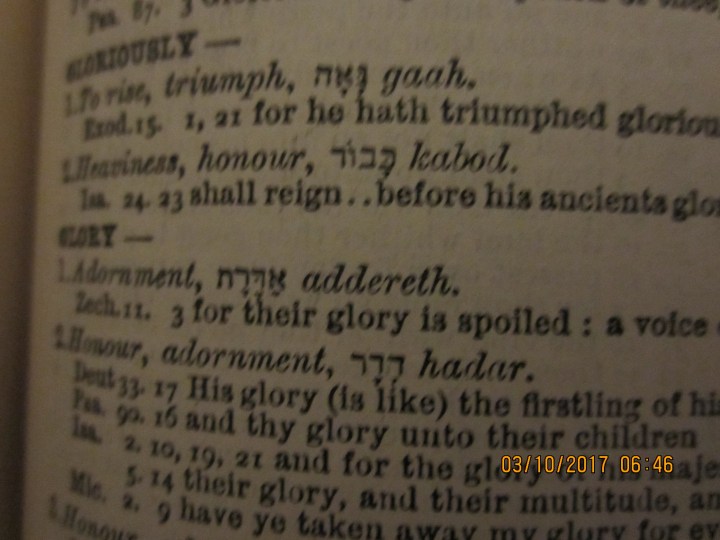
The first thing I realized was that my eyes aren’t as good as they used to be, so I used a page magnifier to get a better look. Still, the eye strain got to me pretty quickly.  The second thing was that there are  several different words translated “glory”, as well as all the variations of the word.  In Strong’s, I counted 15 different Hebrew, and 6 different Greek words. It’s a little more difficult to count in Young’s but I’m guessing the number to be the same, or at least, very close.

The way Strong’s works is that words appearing in the KJV are given in alphabetical order. Under the listing for the English word, scripture references are given, in the order in which they appear. Next to the scripture reference is the phrase from that verse, using the word in question. After the phrase, there is a number. This number either corresponds to a word in the Hebrew/Chaldee or Greek dictionary, both which are located in the back of the book. If the reference is in the Old Testament, use the Hebrew/Chaldee dictionary; if it’s in the New, use the Greek. The dictionary will give the word as it is written in the original language, the English version and then what the word means, and how it is used.

IMG_1924
from Strong’s Exhaustive Concordance

Looking at the first entry under the word glory, I saw that it was in Genesis, and the number was 3519. Looking in the Hebrew/Chaldee dictionary I found the following.

IMG_1925
from Strong’s Exhaustive Concordance

About half the time you read the word glory in the old testament, this was the original word. Kabod means heavy or weighty, as in having value or abundance. Sometimes it is translated as “honor”.

Young’s works a little differently. Under the English word, it gives you different meanings with the corresponding Hebrew or Greek word. Then it gives a scriptural example of that meaning. Using the English spelling of the Hebrew or Greek word, you can go to the back of the book and locate the corresponding word. Then you can see how many ways that word is translated, and how often it is translated a certain way.  It shows kabod translated as glorious ten times, gloriously twice, glory 155 times, honor 29 times, and honorable once.

IMG_1928
from Young’s Analytical Concordance
IMG_1927
from Young’s Analytical Concordance

We could spend a LOT of time researching each of the different Hebrew and Greek words translated as “glory”, but I am discovering that is way beyond the scope of this blog. At least it is for now.

This post from Regina at Daily Bible Study Tips not only explains the usage of kabod, but also covers some of the same territory we did last week. The Holman Bible Dictionary  gives a lengthy definition of glory, using both kabod and the Greek word doxa.

Before we go, let’s look at one more use of kabod.

This takes place after the event involving the golden calf (Exodus 32). God is angry and tells Moses, and the people to go ahead into the promised land, but He isn’t going with them because He might kill them. Moses asks the Lord to reconsider, because they are His people, and how will anyone know that they are God’s people if He doesn’t go with them? God tells Moses that He will do as Moses asks. Then Moses says something extraordinary:

 “Then Moses said, ‘Now show me your glory (kabod).’” (Ex 33:18)

What did Moses mean? There may be a clue in verse 13. Moses says,

 If you are pleased with me, teach me your ways so I may know you and continue to find favor with you.”

I think he wanted to know God as intimately as God knew him. He wanted to know the full weight, the full abundance, that is God. Moses wanted to really see God.  Look what God says to him.

 “And the Lord said, ‘I will cause all my goodness to pass in front of you, and I will proclaim my name, the Lord, in your presence. I will have mercy on whom I will have mercy, and I will have compassion on whom I will have compassion.  But,’ he said, ‘you cannot see my face, for no one may see me and live.’ Then the Lord said, ‘There is a place near me where you may stand on a rock. When my glory passes by, I will put you in a cleft in the rock and cover you with my hand until I have passed by. Then I will remove my hand and you will see my back; but my face must not be seen.‘”(Ex 33:19-33)

Isn’t that amazing?

Connie


The Glory of God

The heavens declare the glory of God; the skies proclaim the work of his hands (Psalm 19:1)

space-galaxy-1401466700kar
Public Domain Photo by NASA

When I started working on this post, I had no idea how broad the subject truly is. Too broad for one blog post, that’s for sure. So, we’re going to stretch it out over a few posts. Even then, I doubt we’ll cover it all. The Bible is just kind of like that isn’t it? There is always more to learn.

In addition to the New International Version (NIV) that I normally use, I will also pull some quotes from the Amplified Version (AMP), to give us a broader picture.

According to Bible Gateway, “The AMP was the first Bible project of The Lockman Foundation. Its goal was to take both word meaning and context into account to accurately translate the original text from one language into another. The AMP does this through the use of explanatory alternate readings and amplifications to assist the reader in understanding what Scripture really says. Multiple English word equivalents to each key Hebrew and Greek word clarify and amplify meanings that may otherwise have been concealed by the traditional translation method. The first edition was published in 1965.”

It’s a great study tool.

I don’t know about you, but every time I hear the phrase “The glory of the Lord”, I think of the Christmas story as it is told in the second chapter of Luke.

Caesar Augustus decrees that a census be taken and in order to comply, Joseph and Mary must travel to Bethlehem. While they are there, she goes into labor, and Jesus is born. Some shepherds nearby get a special birth announcement from heaven and as Luke 2:9 records,

An angel of the Lord appeared to them, and the glory of the Lord shone around them, and they were terrified.

Let’s look at that in the AMP.

And an angel of the Lord suddenly stood before them, and the glory of the Lord flashed and shone around them, and they were terribly frightened.

See what I mean?

Many times we are told someone saw “the glory of the Lord”, without being told exactly what was seen. In Exodus 16, we are told that

While Aaron was speaking to the whole Israelite community, they looked toward the desert, and there was the glory of the Lord appearing in the cloud. (Ex 16:10)

And again, the AMP.

So it happened that as Aaron spoke to the whole congregation of Israel, they looked toward the wilderness, and behold, the glory and brilliance of the Lord appeared in the cloud!

Notice the words shone, flashed, and brilliance? Those words usually describe some kind of light.

Three months after the children of Israel left Egypt, they arrived at the foot of Mt Sinai. God told Moses to instruct the people to prepare themselves for a meeting. These verses don’t specifically say the glory of the Lord, but I don’t know what else you would call it.

On the morning of the third day there was thunder and lightning, with a thick cloud over the mountain, and a very loud trumpet blast. Everyone in the camp trembled. Then Moses led the people out of the camp to meet with God, and they stood at the foot of the mountain. Mount Sinai was covered with smoke, because the Lord descended on it in fire. The smoke billowed up from it like smoke from a furnace, and the whole mountain trembled violently. As the sound of the trumpet grew louder and louder, Moses spoke and the voice of God answered him. The Lord descended to the top of Mount Sinai and called Moses to the top of the mountain. (Exodus 19:16-20)

Can you imagine what it would have been like to stand at the foot of Mt Sinai and watch the Lord descend in what almost sounds like the precursor to a volcanic eruption? I can’t blame them for being scared. Moses went up the mountain and the God spoke to him. When he came back, the people had something to say to Moses.

When the people saw the thunder and lightning and heard the trumpet and saw the mountain in smoke, they trembled with fear. They stayed at a distance and said to Moses, “Speak to us yourself and we will listen. But do not have God speak to us or we will die.”Moses said to the people, “Do not be afraid. God has come to test you, so that the fear of God will be with you to keep you from sinning.” The people remained at a distance, while Moses approached the thick darkness where God was. (Exodus 20:18-21)

God allowed the people to see His glory in order to keep them from sinning. Sadly, the fear didn’t last long, but that is for another post. The next time God descends on the mountain, the scripture says,

and the glory of the Lord settled on Mount Sinai. For six days the cloud covered the mountain, and on the seventh day the Lord called to Moses from within the cloud. To the Israelites the glory of the Lord looked like a consuming fire on top of the mountain. (Ex 24:16-17)

This is the second time fire is mentioned. Let’s look at the AMP.

The glory and brilliance of the Lord rested on Mount Sinai, and the cloud covered it for six days. On the seventh day God called to Moses from the midst of the cloud. In the sight of the Israelites the appearance of the glory and brilliance of the Lord was like consuming fire on the top of the mountain.

There is that word “brilliance” again. Both versions compare what the Israelites saw to a “consuming fire”.

The next few references to the glory of the Lord are kind of interesting because they say that the glory prevents people from entering the place where the glory of the Lord was. With both references, the NIV is first and the AMP follows

Then the cloud covered the tent of meeting, and the glory of the Lord filled the tabernacle. Moses could not enter the tent of meeting because the cloud had settled on it, and the glory of the Lord filled the tabernacle. (Ex 40:34-35 NIV)

Then the cloud [the Shekinah, God’s visible, dwelling presence] covered the Tent of Meeting, and the glory and brilliance of the Lord filled the tabernacle. Moses was not able to enter the Tent of Meeting because the cloud remained on it, and the glory and brilliance of the Lord filled the tabernacle. (Ex 40:34-35 AMP)

When Solomon finished praying, fire came down from heaven and consumed the burnt offering and the sacrifices, and the glory of the Lord filled the temple. The priests could not enter the temple of the Lord because the glory of the Lord filled it. (2 Chron 7:1-2).

When Solomon had finished praying, fire came down from heaven and consumed the burnt offering and the sacrifices, and the [Shekinah] glory and brilliance of the Lord filled the house. The priests could not enter the house of the Lord because the glory and brilliance of the Lord had filled the Lord’s house. (2 Chron 7:1-2 AMP).

Notice that word “Shekinah”? As such, it is never used in scripture, but is a Hebrew word that refers to a physical presence of God on earth as he might appear in an object like fire or cloud. The Amplified Bible includes it thirteen times as an additional explanation. You can find an expanded explanation here

light-background
“Light Effects” PublicDomainPictures.net

What it boils down to is this: God’s actual physical presence is too much for us, so when He finds it necessary to pay someone a physical visit, I guess you could say He cloaks Himself. In the preceding two cases, however, His presence still kept the priests out.

Wow! We still have a lot to discuss, but I think that’s enough for one day. I hope and pray you learned something you didn’t already know, and that you are encouraged to study on your own.

I’ll leave you with what was my grandfather’s favorite benediction. He often closed his services with it.


To him who is able to keep you from stumbling and to present you before his glorious presence without fault and with great joy— to the only God our Savior be glory, majesty, power and authority, through Jesus Christ our Lord, before all ages, now and forevermore! Amen (Jude 1:24-25)

Connie


Let There Be Light

Good morning! As I write this, the sun has yet to come up, although the sky is beginning to lighten. My living room has an east-facing picture window, which gives me a glorious view of the sunrise every morning. Daylight will be here soon!

img_1743
Sunrise picture taken from my front porch last September.

The Bible mentions light a lot; 263 times to be exact. That number is based on a search I did at Bible Gateway. The search results included a few other light including words, such as “lightning” and “lighten”, but most were simply “light”.

The first book of the Bible is called “Genesis”, which means “Origin” or “Beginning”. It is the record of the beginning of the earth and the beginning of mankind. The first thing we learn in verse one of chapter one is that God was there, in the beginning. The earth was formless, empty, and dark. It was also wet, because we are told that the Spirit of God hovered over the face of the water. (Genesis 1:1-2)

Then, in verse three, we read the first recorded words of God: “Let there be light”. The rest of the verse, and the two after, tells us there was light, and God saw that the light was good. That was the first day (Genesis 1:3-5).

Verses six through eight tell us how God created the sky, nine and ten tell how He gathered the water so that dry ground appeared, and 11 through 13 describe the creation of vegetation. On day four, God called the sun, moon, and stars into being (Gen 1:14-19).

img_1794
This picture of the moon was taken from practically the same spot, last October.

Did you catch that? God called the sun, moon and stars into being on day four, after he had created the atmosphere, dry land, and plant life, and after he had created light.

If it wasn’t the sun, what was that first light? We don’t know for sure, but the scriptures give us some clues.

John says, “This is the message we have heard from Him and declare to you: God is light, in Him there is no darkness at all.” (1 John 1:5).

Daniel writes that “He (God) reveals deep and hidden things, He knows what lies in  darkness and light dwells with Him.”(Daniel 2:22).

The most revealing verses, however, come from Revelation. Jesus has returned, Satan has been defeated, and everything is new. In describing the “new Jerusalem”,  John writes,

“The city does not need the sun or the moon to shine on it, for the glory of God gives it light, and the Lamb is its lamp.” (Revelation 21:23)

Then he says,

“There will be no more night. They will not need the light of a lamp or the light of the sun, for the Lord God will give them light. And they will reign for ever and ever.” (Revelation 22:5)

Again, we can’t know for sure, but that sure makes me think that the light of creation came from God Himself!

Next time, we’ll look at what the scriptures say about some human encounters with that kind of light.

A  friend shared this video from Patsy Clairmont on Facebook the other day. I thought it relevant to our discussion.

Isn’t God awesome?

Let there be light!

Connie

Hi There!

If you grew up in church like I did, there is a very good chance that you know this song…You probably know it if you only occasionally attended Sunday school or Vacation Bible school.

This little light of mine
I’m gonna let it shine
This little light of mine
I’m gonna let it shine

Let it shine
Let it shine
Let it shine

Hide it under a bushel, NO!
I’m gonna let it shine
Hide it under a bushel, NO!
I’m gonna let it shine

Let it shine
Let it shine
Let it shine

Won’t let Satan blow it out
I’m gonna let it shine
Won’t let Satan blow it out
I’m gonna let it shine

Let it shine
Let it shine
Let it shine

Let it shine round (your town’s name)
I’m gonna let it shine
Let it shine round (your town’s name)
I’m gonna let it shine

Let it shine
Let it shine
Let it shine

Let it shine til Jesus comes
I”m gonna let it shine
Let it shine til Jesus comes
I’m gonna let it shine

Let it shine
Let it shine
Let it shine

You sang along didn’t you?

Doing a little research into the song itself, (you’ll find out that I’m a bit of a history buff), I found that, according to Wikipedia, the lyrics were written by Avis Burgeson Christiansen, and the music by Harry Dixon Loes, some time around 1920.  You can read the Wikipedia article here. Other sources did credit Loes with the tune (here’s one), but I haven’t found any other sources giving Christian credit for the lyrics. Some sources list it as a Negro spiritual.

While the identity of the lyricist is up in the air, the ultimate source for the lyrics is not. They come straight from scripture. Matthew chapter five begin what we now know as the “Sermon of the Mount”.  Jesus is speaking to a large crowd of people. In  verses 14-16 he says,

“You are the light of the world. A town built on a hill cannot be hidden. Neither do people light a lamp and put it under a bowl. Instead they put it on its stand, and it gives light to everyone in the house. In the same way, let your light shine before others, that they may see your good deeds and glorify your Father in heaven.”

So, this blog, what is it all about?

Well, first of all, its about Jesus, the Light. Everything we do here is for his glory. So, we’re going to talk about him as the Light and as the Word. We’re going to dig into scripture to see what God has to say to us.

Then, it’s about us…the light bearers. It’s about letting his perfect light shine through our less than perfect lives, and allowing that light to transform those lives. When others see His light shining through us, it guides them to Him. That’s why we’re here!

Because music is an integral part of worship, we’ll be talking about music too, as well as composers and lyricists. They are light-bearers too, and many serve as great examples for us.

Anyway, thanks for stopping by for my first post. I’ll be back soon.

Connie